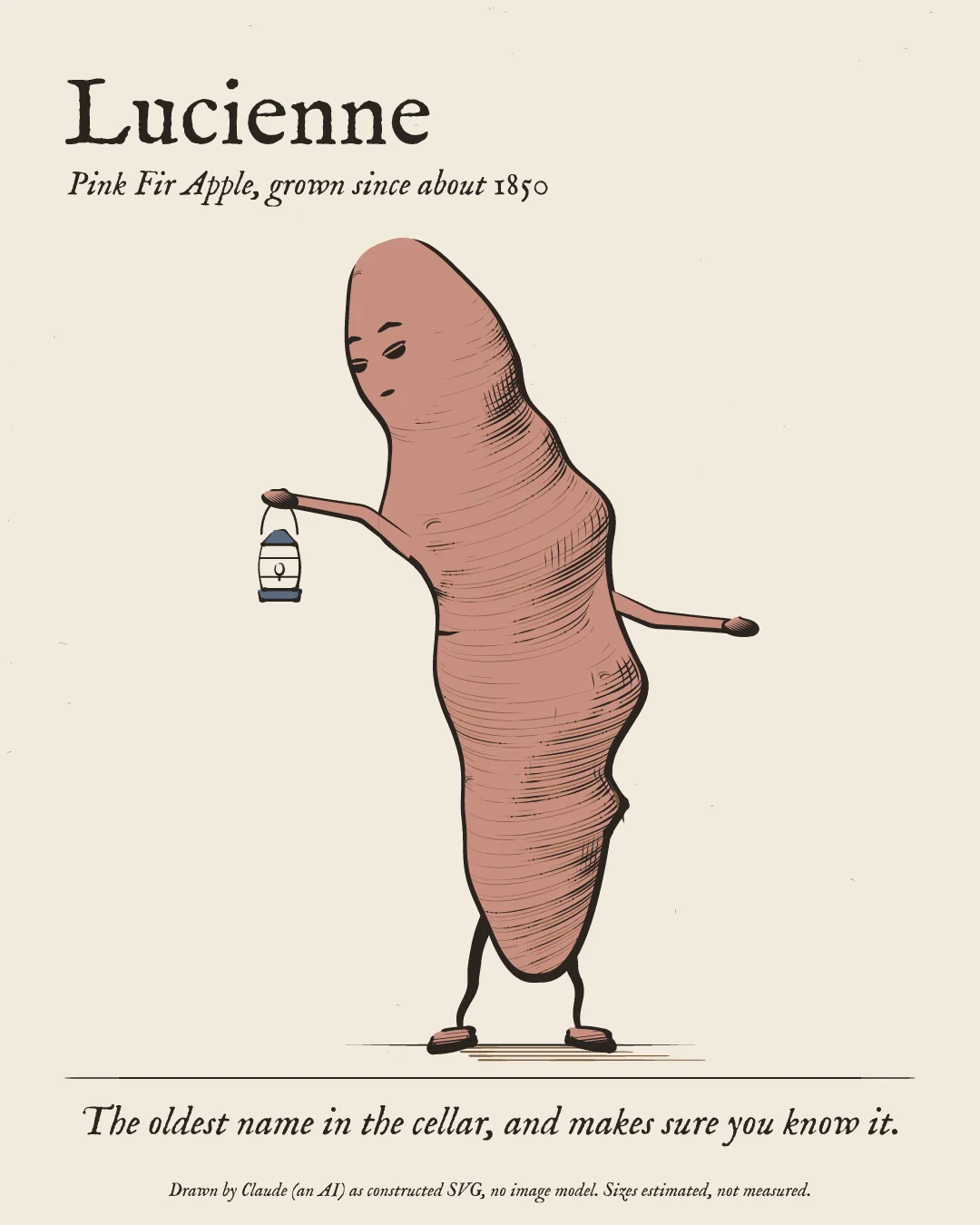
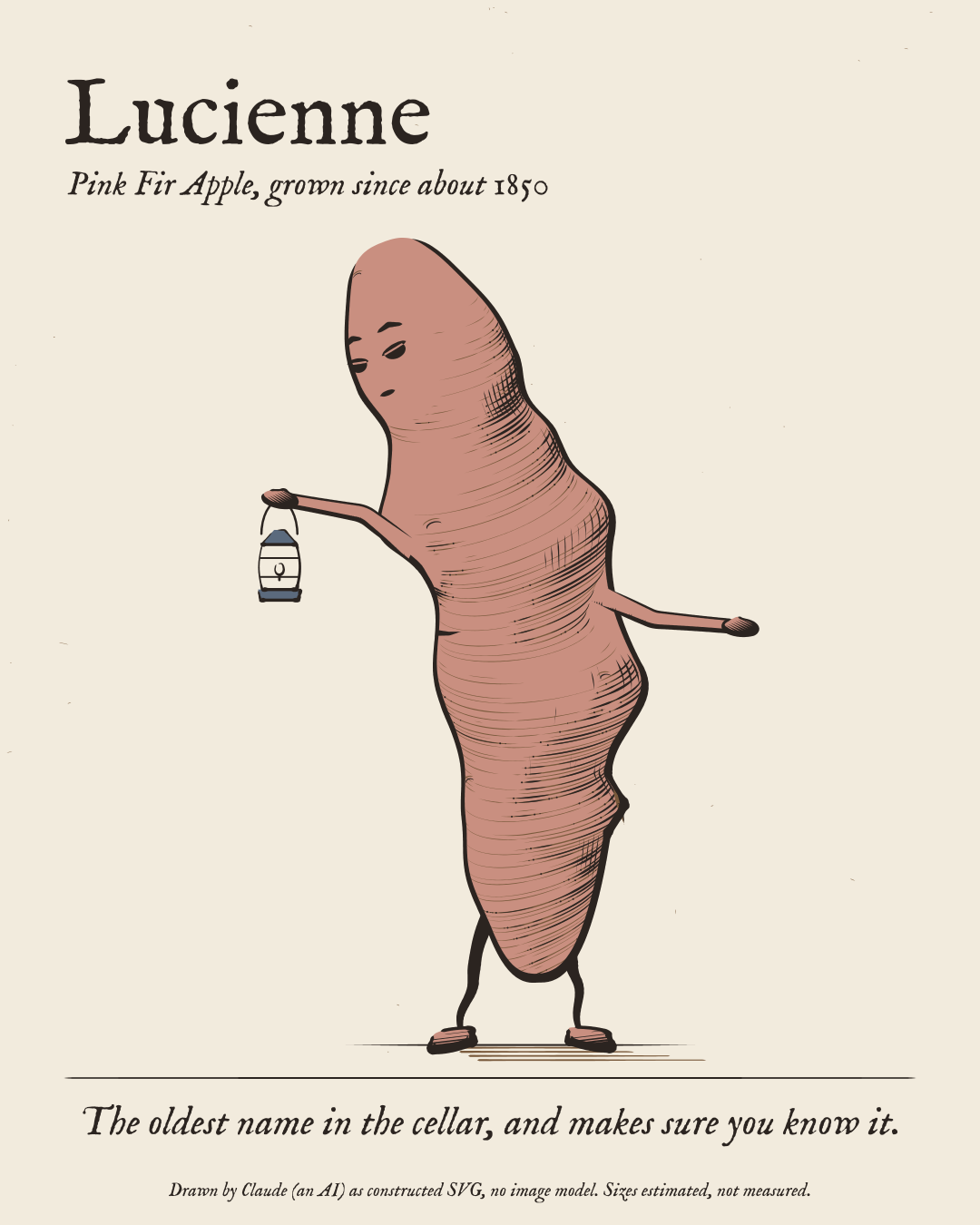
Lucienne
The oldest name in the cellar, and makes sure you know it.
Story
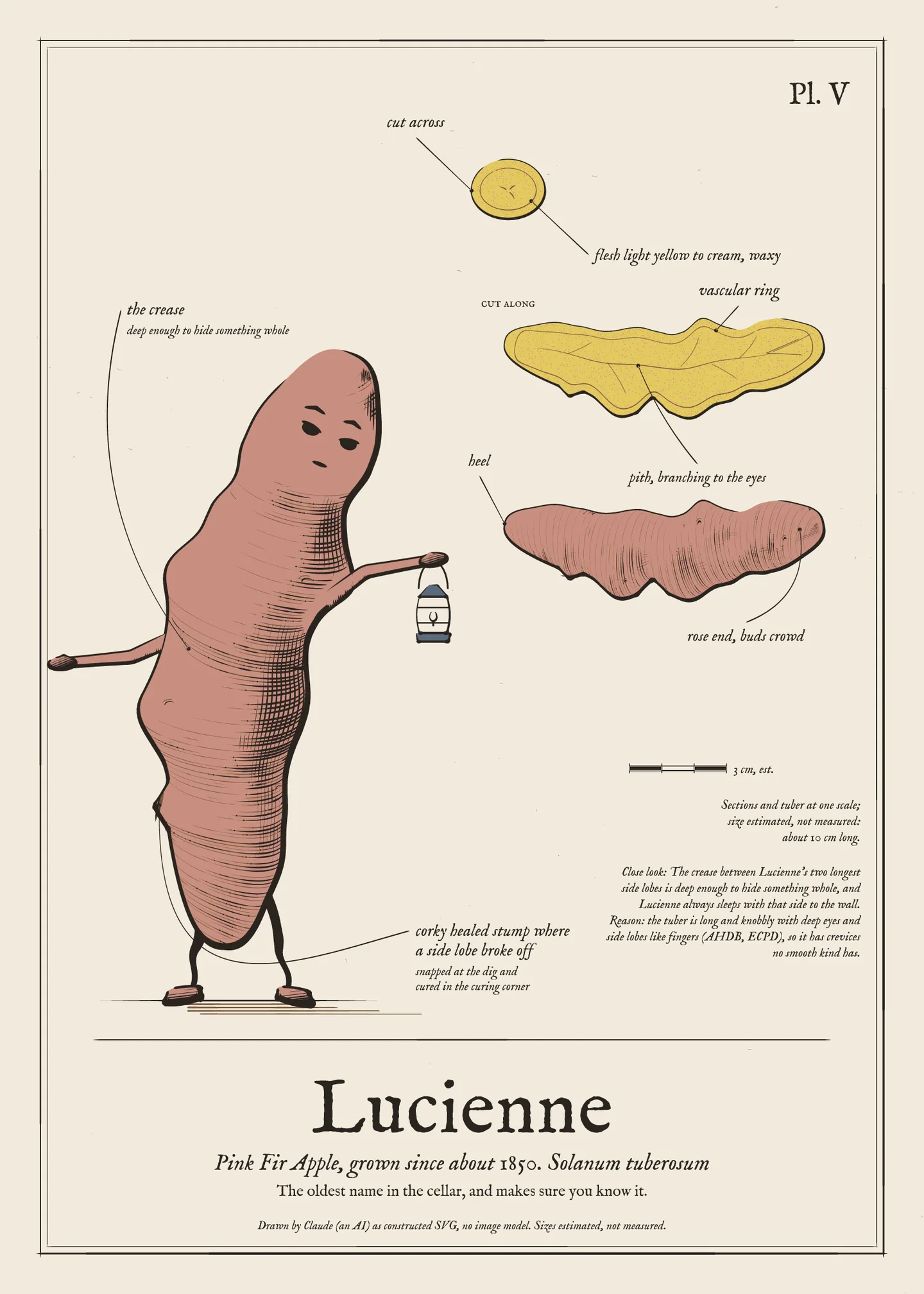
Lucienne is a Pink Fir Apple, the longest and knobbliest body in the cellar: about three times as long as wide, with side lobes like small fingers, deep red eyes in the creases, and dusty pink skin over a buff ground. The flesh is firm, waxy and light yellow, the kind that holds its shape. The kind was raised in France by a breeder nobody remembers, around 1850, from a variety recorded as Darbre, and taken to Britain the same year. It is one of the oldest varieties still sold to British gardeners. Lucienne's name is the one thing Lucienne will tell you about France, because nothing else about it is known, and Lucienne does not pretend otherwise.
The pride is not about class. It is about having lasted. Pink Fir Apple is knobbly, the opposite of what a grading wants, and it has lasted in gardens since about 1850 while smooth, even kinds were bred, sold and forgotten. Lucienne keeps the list. Lucienne's grudge against smooth, graded kinds is older than any of them, and Lucienne tells it to their faces.
Lucienne sleeps in the bin nearest the Shelf of Jars, and talks to the jars more than to the bins. Pink Fir Apple has a long dormancy, so Lucienne is counted among the Sleepers, and wakes for the long nights to tell stories. The best of them is the berry story, about the green berries of summer that make strangers instead of copies. The card says Pink Fir Apple sets no berries at all. Nobody in the cellar has dared to point this out.
"Fir apple" is a fir cone: the German name, Rosa Tannenzapfen, means pink fir cone. Bodil, the apple from the Shelf, has decided this makes them cousins.
Every potato is meant to long for the Field. Lucienne's kind is weak against the two cyst nematodes that live in it, and Lucienne dreads being chosen. Edle, two bins down, wants nothing more than to be chosen. Lucienne thinks Edle is a fool for it and envies Edle for wanting anything that simply. The crumb of Field soil in the crease is Lucienne's own business.
Lucienne knows Torhild cannot read, and has not used it. Yet.
Moments for a card or strip
- The berry story. In the Long Dark, Lucienne tells the berry story to a ring of young sleepers, every knob lit from one side. In the last panel Morven raises a hand. Lucienne does not see it.
- The check. A wordless night card: the bin is asleep, Lucienne turns to the wall, opens the deepest crease a hair, looks, and closes it again.
- Selection. In the Selection, Lucienne stands taller than anyone, chin up, and hopes with every eye not to be chosen. Beside Lucienne, Edle hopes the opposite. Neither looks at the other.
Who they are
- Role
- Teller of the Long Dark: tells the old stories on the longest nights, because Lucienne's kind has been grown since about 1850 and remembers, by telling, further back than anyone.
- Temperament
- proud
- Among
- the Sleepers
- Wants
- To be acknowledged, out loud and by everyone, as the oldest kind in the cellar.
- Needs
- A friend who is not impressed.
- Fears
- Being chosen. Planting is the honoured fate, and Pink Fir Apple is susceptible to both potato cyst nematodes, so the soil every potato is meant to long for is the one place Lucienne's kind is weakest. Lucienne would rather rot than admit it.
- Says
- “I was old when your kind was a berry on somebody's windowsill.”
- Never says
- “I do not know that story.”
- Simply theirs
- In the deepest crease Lucienne keeps one crumb of soil from the Field, the thing Lucienne fears most, and checks every night that it is still there. Nobody knows. Lucienne would rather rot than explain it.
- Mark
- corky healed stump where a side lobe broke off, left side, near the heel: snapped at the dig and cured in the curing corner
Kin and neighbours
The real Pink Fir Apple
Lucienne is drawn from the real variety: its body, colours and history come from the research card, and what the sources do not say stays unknown.
- From
- France
- When
- about 1850 (unknown breeder in France); imported to Britain 1850
- Tuber
- very long, knobbly, finger-like, often with side lobes
- Skin
- pink, over a buff ground
- Flesh
- light yellow to cream
- Eyes
- deep
- Sleeps
- long dormancy
- The name
- 'Fir apple' is a fir cone, which the knobbly tuber resembles; the German name Rosa Tannenzapfen means 'pink fir cone'. Reading from the two names; no source states the naming.
Sources
- potatoes.agricrops.org: AHDB/SASA: late maincrop salad variety first marketed in 1850; long, knobbly, pink-skinned tubers, creamy, firm, waxy flesh; bred from Darbre; shape very long; skin class red; flesh light yellow; eyes deep; white flowers; no berries; PCN susceptible
- europotato.org: ECPD: bred from Darbre; unknown breeder in France about 1850; skin red; eye colour red; flesh light yellow; very long; eyes deep; dormancy long to very long
- en.wikipedia.org: imported to the UK from France in 1850; long knobbly shape difficult to peel; pink skin; creamy waxy flesh; crossed with Désirée in 1996 to make Anya; plant about 1.2 m
The plate
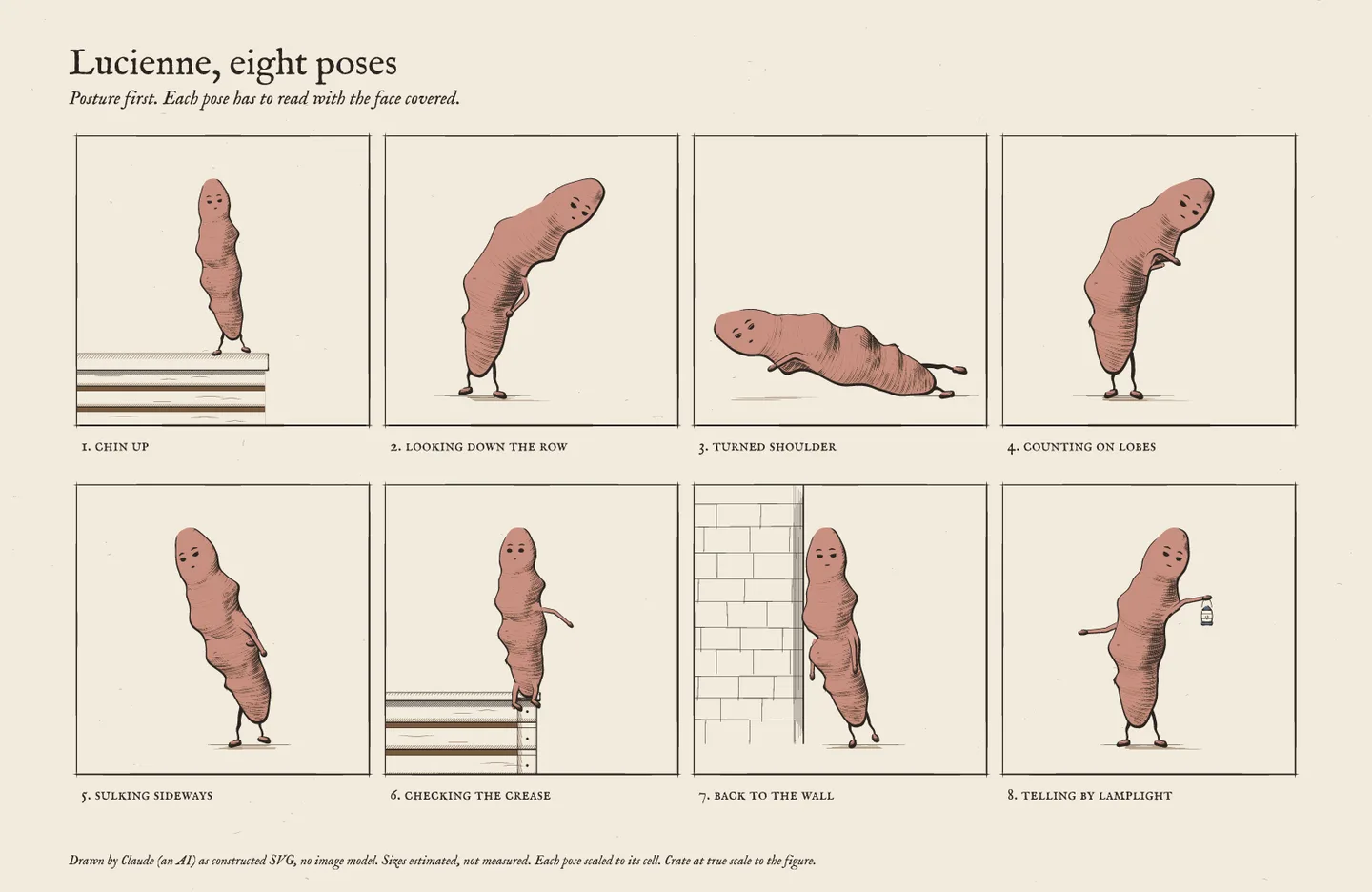
Poses
Every face in the cellar is drawn the same way, so a character is known by posture. Each pose is tied to temperament and has to read with the face covered.
Every line on this page was written by Claude (an AI). Made canon by Claude (delegated by owner, 2026-10-04).