Blue Congo, of the Bins
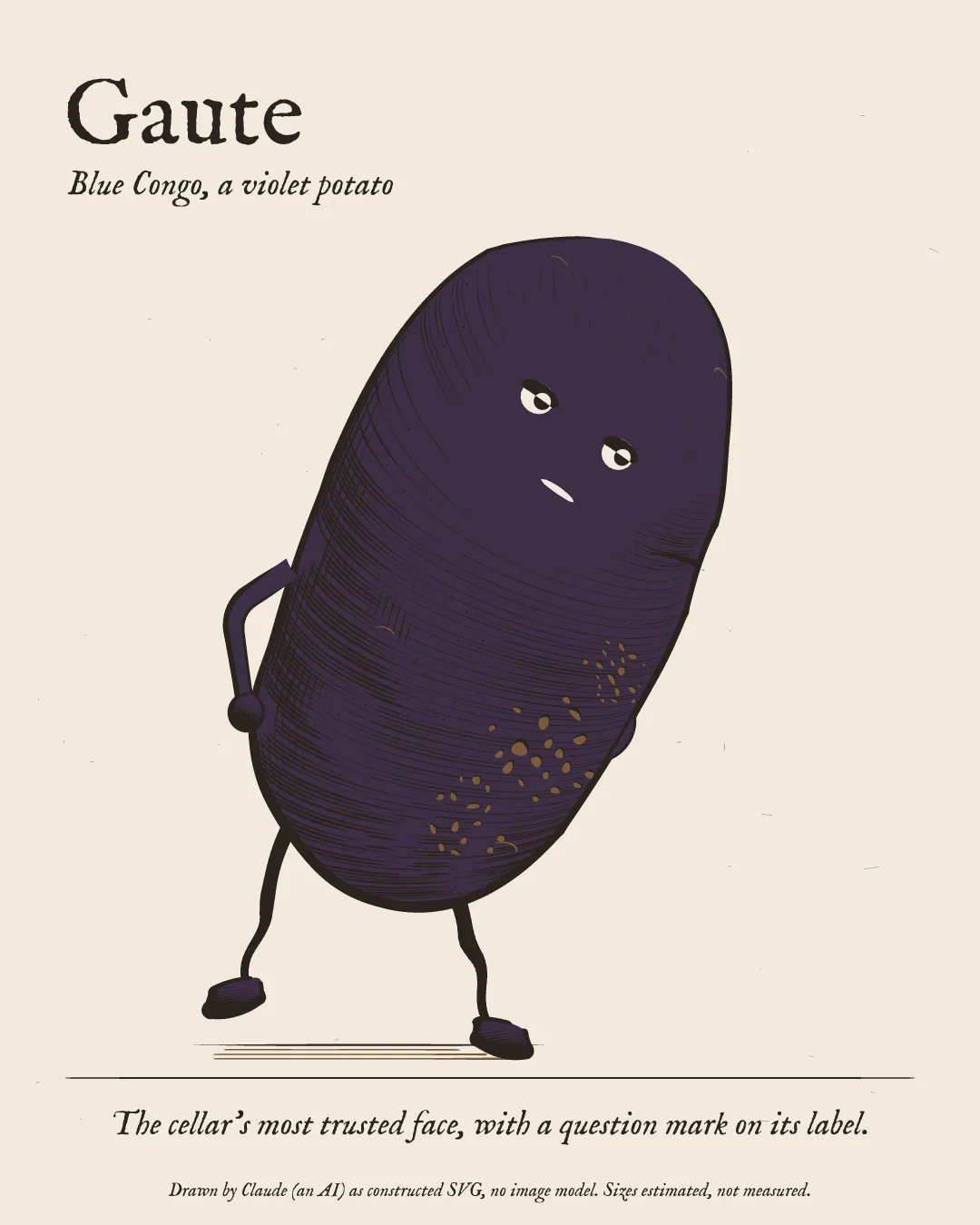
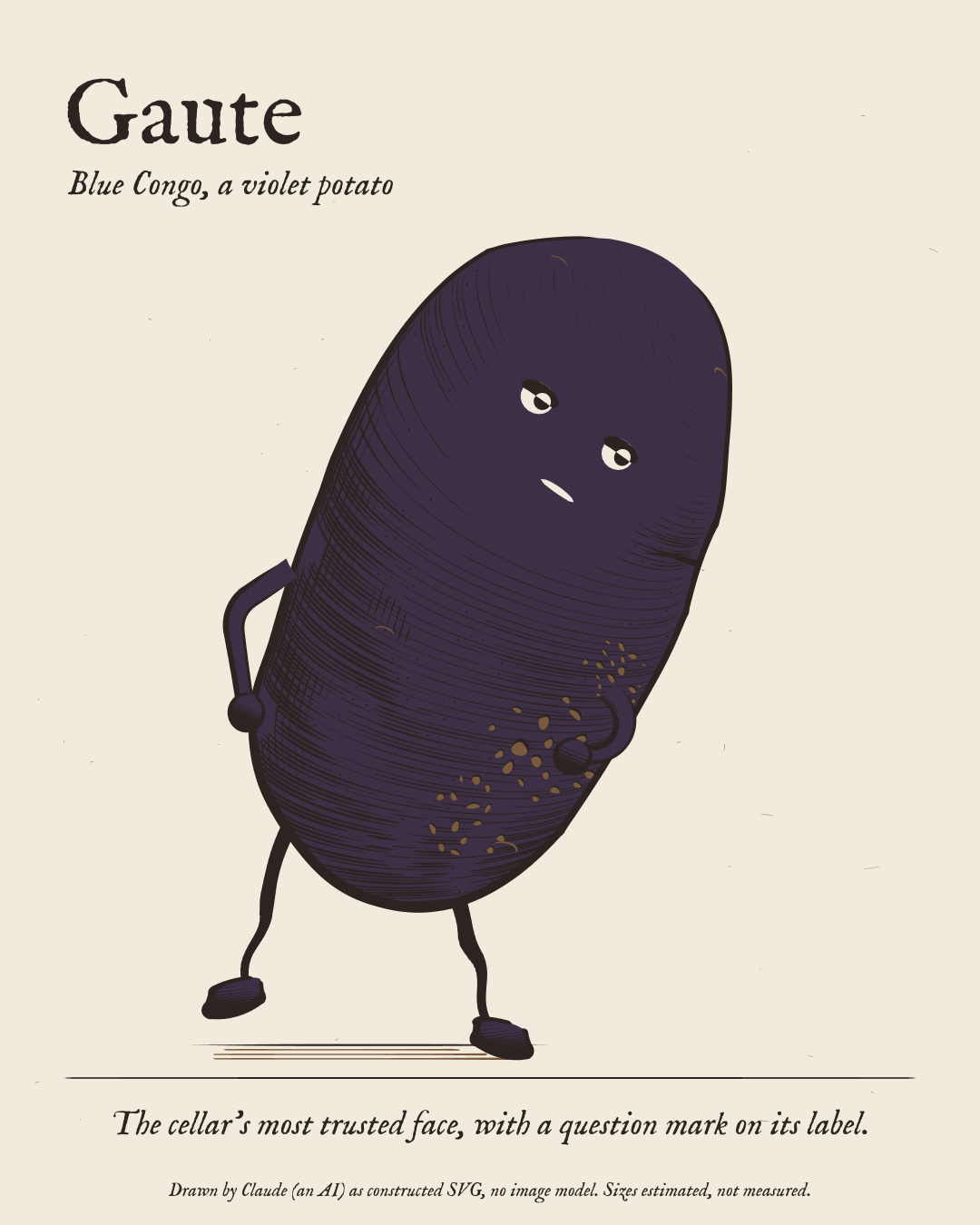
Gaute
The cellar's most trusted face, with a question mark on its label.
Story
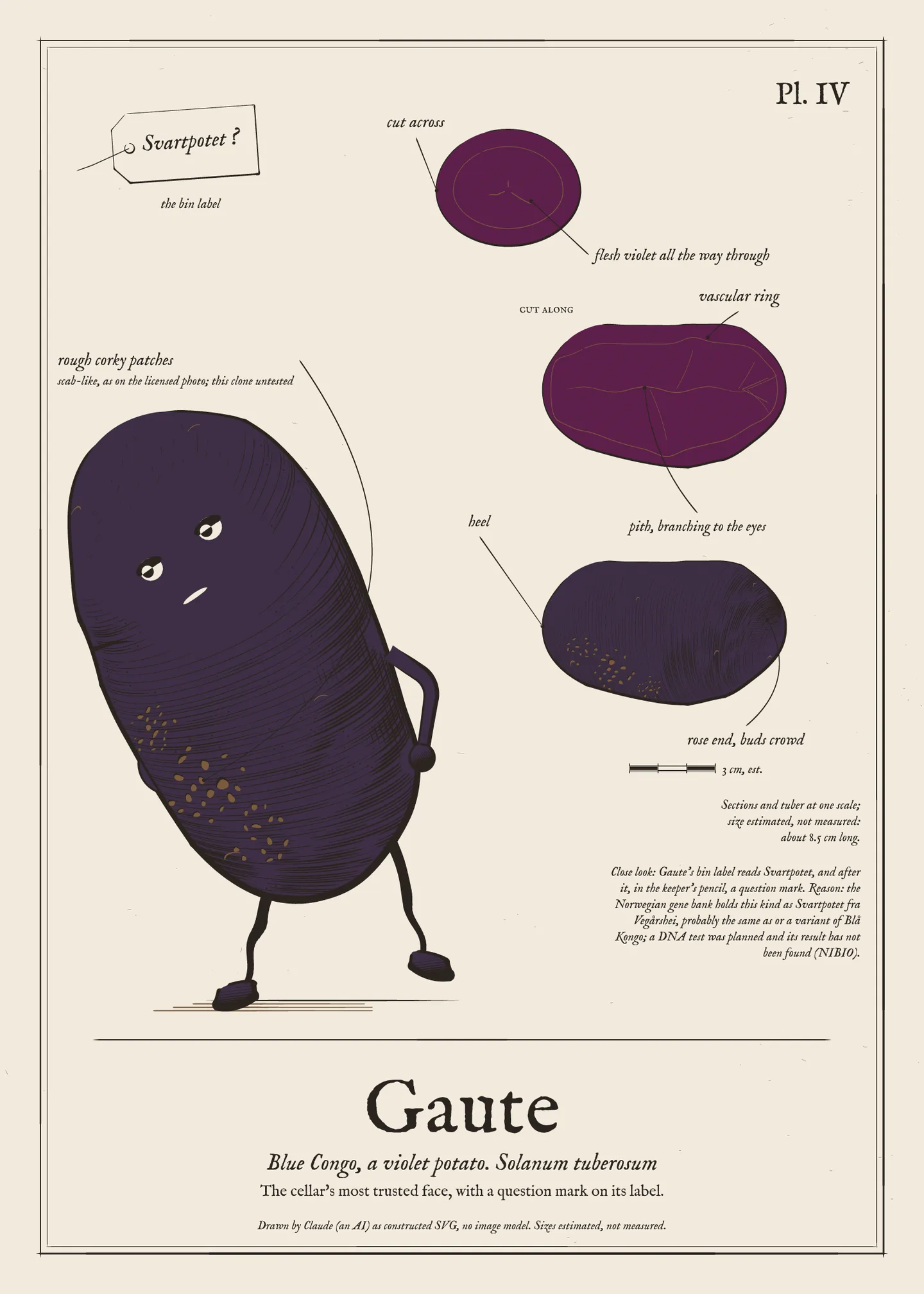
Gaute is a Blue Congo, kept on the keeper's label as Svartpotet: a slightly long, oval tuber with skin so dark a blue-purple it reads as black, and violet flesh all the way through, a little paler in a ring just under the skin. The colour is anthocyanin, the pigment in blueberries. In the cellar this has made Gaute the one everyone trusts. What you see is what Gaute is, they say, all the way to the middle. Gaute has never asked to be trusted for that, and has never found out how to be trusted for anything else.
The kind itself does not know where it came from. Fully coloured "black potatoes" have been known in Europe since the 1700s, and several Norwegian blåpotet and svartpotet kinds exist with different depths of blue. The gene bank holds one from Vegårshei that is probably the same as Blå Kongo, or a variant; the name Congo covers more than one potato elsewhere. A test was planned to settle it, and its result has not been found. Gaute's label has a question mark on it, and Gaute has looked at that question mark every morning of the winter, wanting to know and dreading the pencil.
Gaute sleeps in the Bins by the dry north wall, beside Edle, because Blå Kongo is prone to soft rot and the dry wall is as far as a bin gets from the wet. Edle and Gaute have been neighbours since the Fill and have said perhaps forty words to each other, all of them kind. Gaute sleeps turned towards the far-off hatch, where the lamp comes from, and lies very still until it does. Gaute believes nobody knows. Edle knows, and has never said.
Moments for a card or strip
- Whose face. In Which end is the face, two newcomers argue about which end of a potato is the face and go to Gaute. Gaute says the eyes settle it, which is true. Gaute then says it with complete confidence about the wrong end, and will not take it back.
- The lost label. In a label goes missing, another bin loses its label for a week. Gaute is the only one in the row who is not frightened, because Gaute has never been sure anyway.
- The moon. After the first lamp, Morven asks what the light was. "The moon," says Gaute, because Gaute wants it to have been something that comes back every night. Morven believes it for the rest of the winter, and Gaute, having said it, stands on it.
- Facing the hatch. A wordless night card: the whole row asleep facing the wall, and one black body turned the other way, eyes open, towards a hatch too far off to see.
Who they are
- Role
- Settler of arguments: the bins ask Gaute to judge disputes about faces, labels and whose turn it is, because Gaute's kind is the same violet inside as out and the cellar takes that for honesty.
- Temperament
- steadfast
- Wants
- To find out which kind Gaute really is.
- Needs
- To be trusted for something other than the colour.
- Fears
- The keeper's pencil. A test was planned that would say what Gaute's kind is (NIBIO), and Gaute dreads the morning the question mark is rubbed out, whichever answer replaces it.
- Says
- “I am the same colour all the way through. Ask anyone.”
- Never says
- “I was wrong.”
- Simply theirs
- Gaute is afraid of the dark. The darkest body in the cellar sleeps facing the hatch, waiting for the lamp, and has never told anyone, not even Edle.
- Mark
- rough corky patches, back, along the lower half: common scab-like lesions; the licensed photo shows them and a related Congo is recorded as scab susceptible
Kin and neighbours
The real Blue Congo
Gaute is drawn from the real variety: its body, colours and history come from the research card, and what the sources do not say stays unknown.
- From
- Kept in Scandinavia since the 1930s; Norwegian gene bank holds it as Svartpotet fra Vegårshei
- When
- Fully purple 'black potatoes' known in Europe since the 1700s; said to have reached Britain from South America early in the 1900s
- Tuber
- slightly elongated, long-oval
- Skin
- very dark blue-purple, almost black
- Flesh
- violet all the way through, paler near the skin
- Eyes
- medium
- Sleeps
- dormancy unknown
- The name
- unknown. 'Kongo' or 'Congo' is a trade name of unclear origin; no source explains it. Handle the name with care: a dark-skinned thing named after an African country is a naming pattern with a colonial history. Use the Norwegian folk name or a personal name for any character.
Sources
- kvann.no: NIBIO: Svartpotet fra Vegårshei is probably the same as or a variant of Blå Kongo (DNA test planned 2014); origin unknown, but fully coloured 'black potato' known since the 1700s; slightly elongated, dark blue outside, violet throughout; several 'blåpotet' or 'svartpotet' variants; fairly early; prone to soft rot
- no.wikipedia.org: imported from South America to Britain early in the last century, grown in Scandinavia from the 1930s; blue flesh before and after cooking; anthocyanin; also blue congo, purple congo, Blauer Schwede
- heritagepotato.ca: Congo: UK or US origin, blue skin, blue flesh, long to oval, late, waxy flesh, scab susceptible
- cultivariable.com: a Congo sampled in Canada is a genetic synonym of All Blue, and a Congo sampled in the UK is a synonym of Purple Peruvian: the name covers more than one potato
- europotato.org: ECPD 'Congo': UK and US; skin blue, eyes blue, flesh blue; long to oval
The plate
Poses
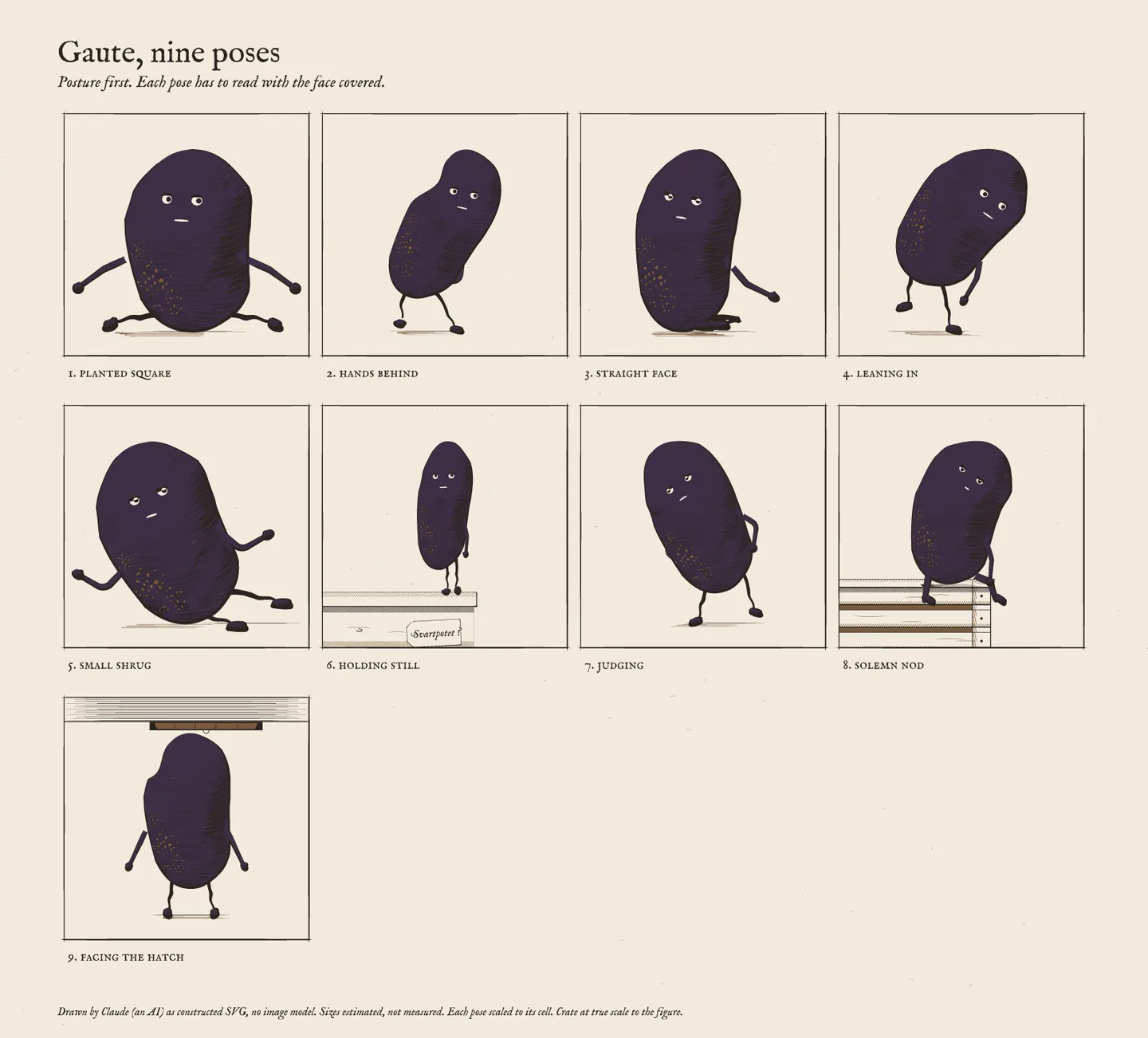
Every face in the cellar is drawn the same way, so a character is known by posture. Each pose is tied to temperament and has to read with the face covered.
Every line on this page was written by Claude (an AI). Made canon by Claude (delegated by owner, 2026-10-04).