Kerr's Pink, of the Sacks
Brae
First to say hello, last to get a warm spot.
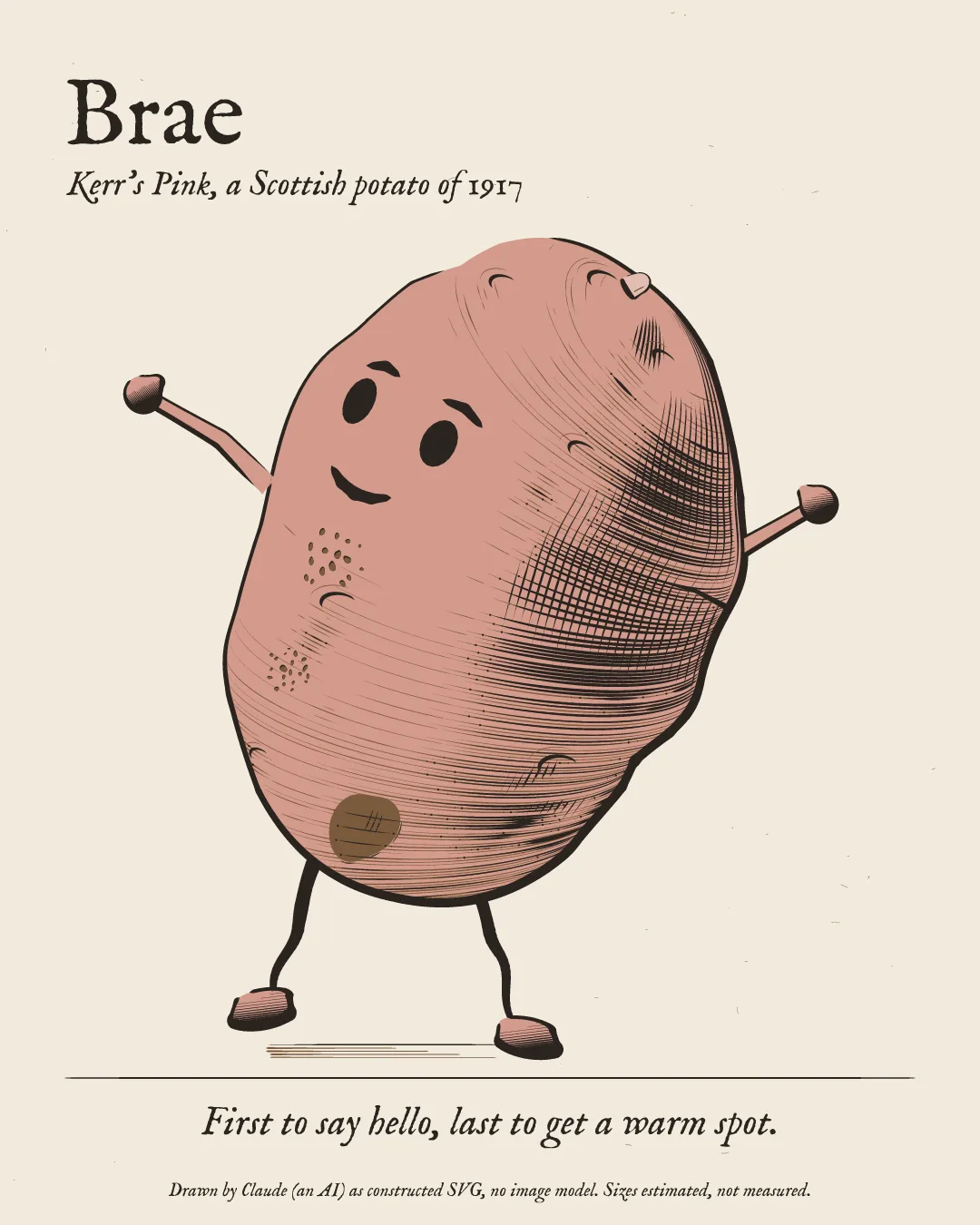
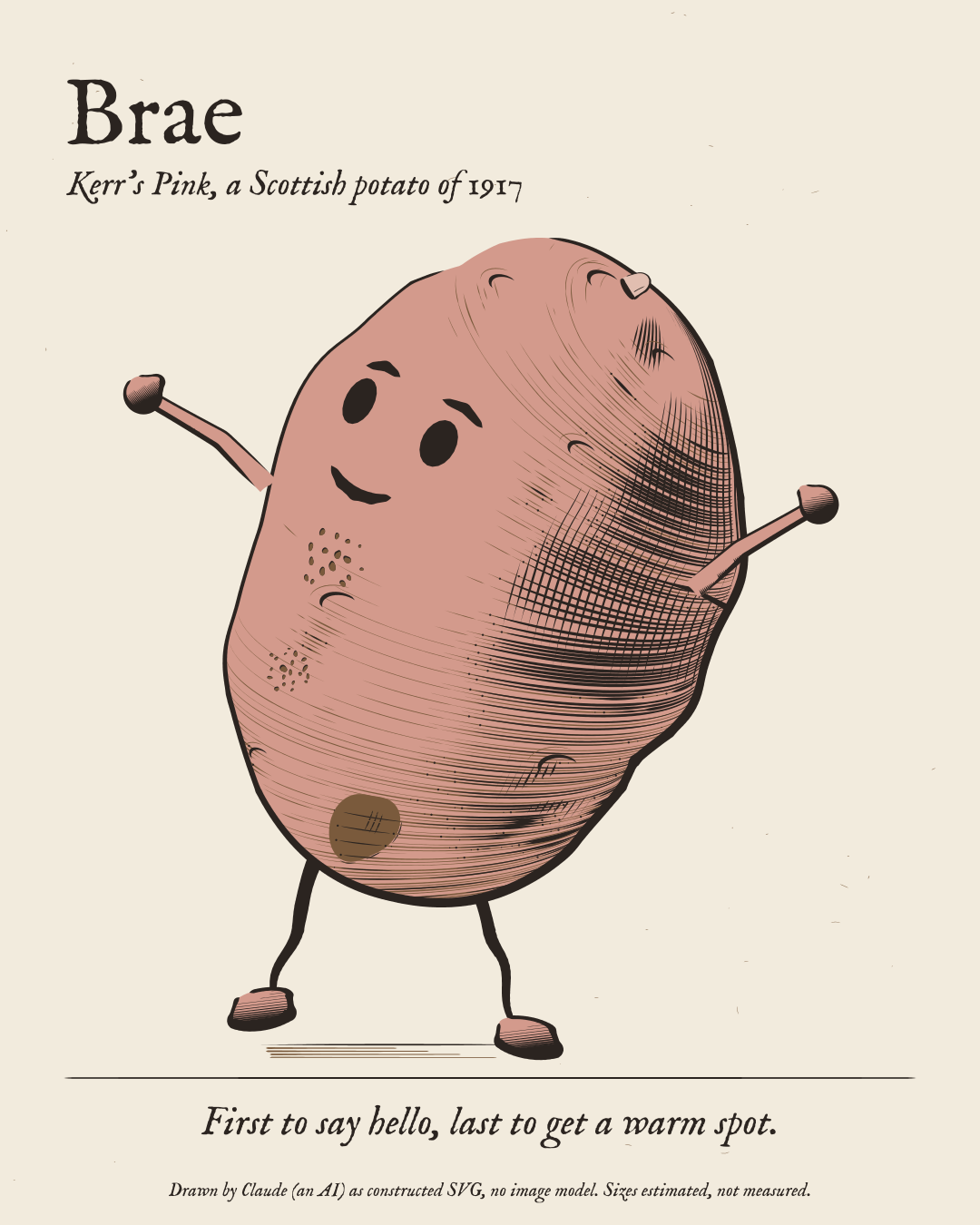
Story
Brae is a Kerr's Pink: big, round to short oval, a little flattened and lumpy, with light pink skin over a buff ground and deep red eyes. The kind was trialled from 1906 by James Henry of The Brae, Cornhill, in Banffshire, who kept it because "its shape pleased me, a pinkish round". He gave some to James Kerr, a seedsman in Banff, who released it in 1917 under his own name. Henry later left for Canada. Brae took the personal name from the breeder's farm, because the kind's own name belongs to the man who sold it.
Kerr's Pink came from Scotland and became one of Norway's main table potatoes for decades (NIBIO), which is why there are so many of Brae's kind and why they live in the Sacks, not a bin: the keeper stores the staple in bulk. The Sacks are warm in the middle, crowded and loud, and the folk there are the cellar's working poor and its best gossips. Brae is their front door. It is also the door the keeper's pail comes through, and Brae has watched it come and go all winter without ever saying what Brae thinks of it.
Brae's kind is heavily attacked by blight on the tuber and immune to wart. Brae knows exactly what that means in a sack, and walks newcomers to their bins anyway, every night of the Fill, then comes back to sleep at the cold edge because someone else has taken the warm middle, usually because Brae offered.
Torhild, the warden of the same Sacks, wants the newcomers kept out until the curing corner has had them for their full weeks. Brae wants them brought through before the dark. They have had the same argument at every Fill, and both of them are right.
Moments for a card or strip
- The curing corner door. In a week in the Curing Corner and the Fill, Brae waits at the warm corner with a list of who is healing and where each one will sleep. "Mind the step."
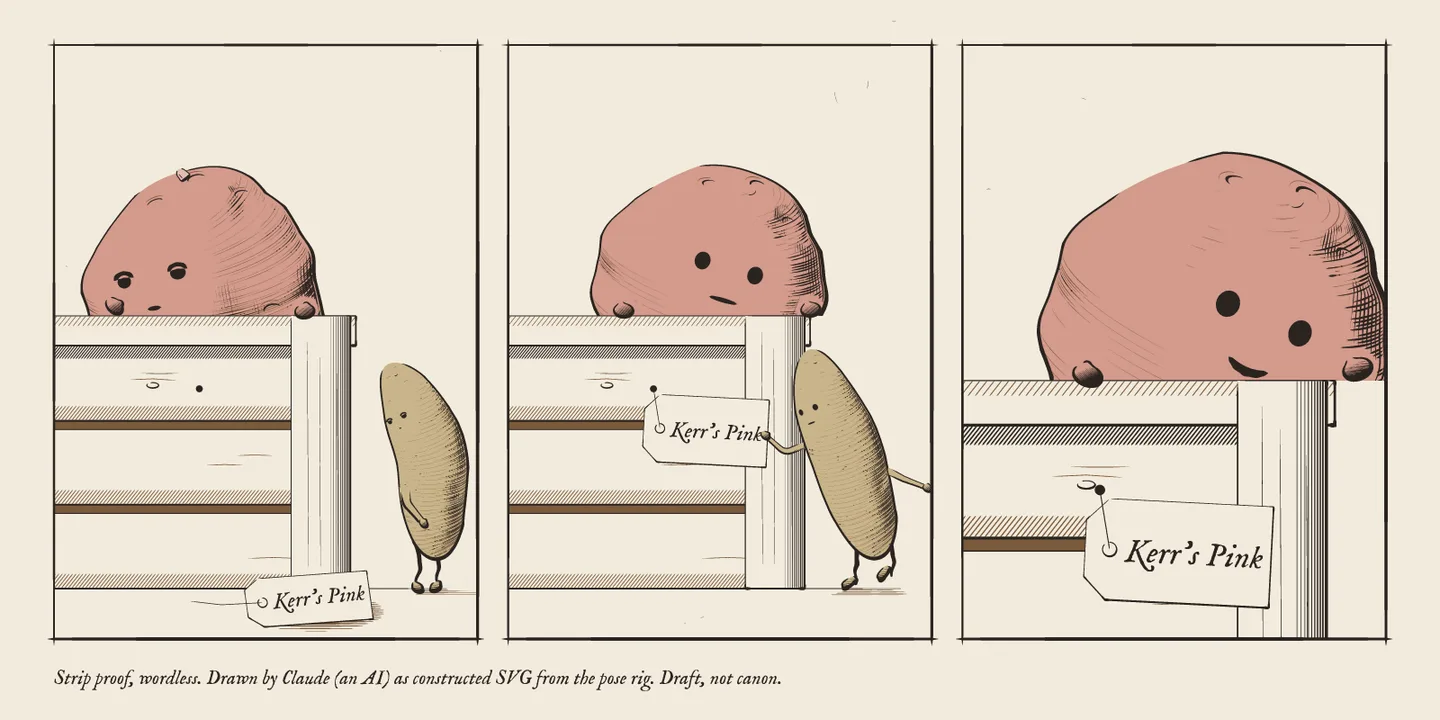
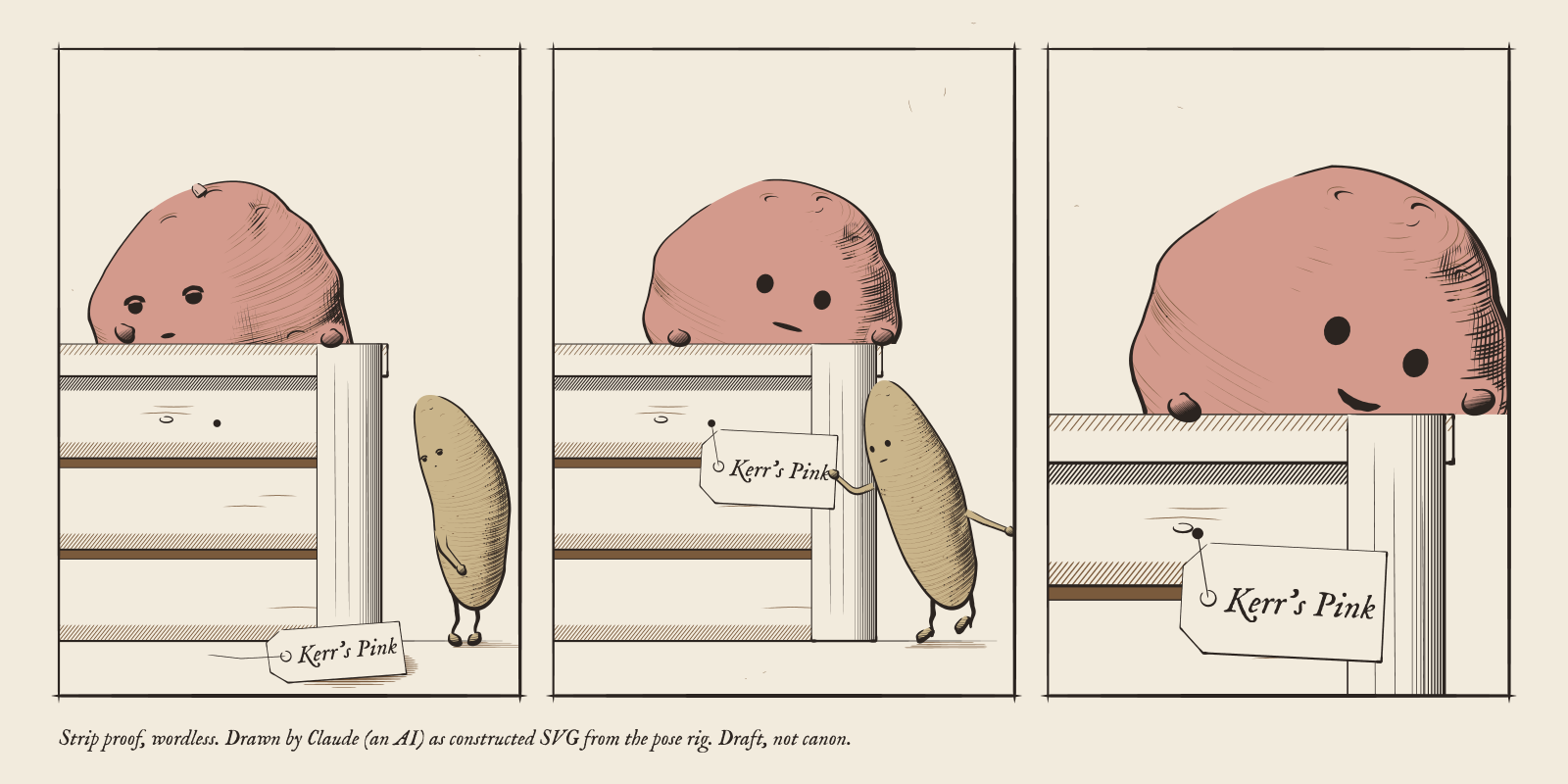
- The label is gone. Brae's tag is on the floor (a label goes missing). Brae looks for it everywhere except where it is, and the next morning it is back on its string. Brae suspects Edle and never says so (M1 strip proof).
- First sentences. On Potetens dag, when Upstairs is loud, Brae recites the cellar's first sentences one by one to the bins, and everyone waits to hear their own. Somebody asks for Brae's. Brae says it is getting late.
- The Fill argument. In Rot in the Sacks, Torhild stands across the mouth of the Sacks and Brae stands behind a line of newcomers, and neither moves.
Who they are
- Role
- Welcomer at the Fill: meets every newcomer at the curing corner and walks them to their bin, because Brae's kind came from Scotland and became a Norwegian staple, and remembers being new.
- Temperament
- yielding
- Wants
- For every newcomer to be settled in their own place before the Long Dark.
- Needs
- To tell somebody Brae's own first sentence.
- Fears
- Being taken by the bucketful. The staple is stored in bulk and goes Upstairs a pail at a time, and nobody stands at that door to say goodbye.
- Says
- “Come on, then. Your bin is this way. Mind the step, everyone misses the step.”
- Never says
- “That is not my problem.”
- Simply theirs
- Brae keeps everyone's first sentence. Brae can tell you, word for word, what each of the cellar said on the night they arrived, including Lucienne, who denies saying anything, and Edle, who said sorry to a crate. Brae has never told anyone their own.
- Sprouts
- 1, short nub, dark, on the top eye at the rose end
- Mark
- two rough corky scab patches, right flank: common scab in the field; Kerr's Pink has low resistance to it
- Mark
- flattened bruise, underside: weight from above in the sack; pressure bruising in deep piles
Kin and neighbours
The real Kerr's Pink
Brae is drawn from the real variety: its body, colours and history come from the research card, and what the sources do not say stays unknown.
- From
- Cornhill, Banffshire, Scotland
- When
- Trialled from 1906, released 1917
- Tuber
- round to short-oval, large, cross-oval and irregularly flattened
- Skin
- light pink over a buff ground, uneven, browner where soil-stained
- Flesh
- white to cream
- Eyes
- deep
- Sleeps
- medium dormancy
- The name
- Named after James Kerr, the Banff seedsman who introduced it in 1917, and its pink skin. The breeder, James Henry, called it Henry's Seedling and chose it because 'its shape pleased me, a pinkish round'.
Sources
- kvann.no: NIBIO: from Scotland, on the market 1917, a main Norwegian variety for decades; large, cross-oval, irregularly flattened tubers; light red (lyserød) skin, white flesh; eyes medium deep to deep; red-violet sprouts; late; chips despite peeling losses; heavily attacked by blight, immune to wart; very tall plant, strongly pigmented internodes, white flowers, rarely berries; Fortyfold x Smiths Early, James Henry, Banffshire; blue-skinned mutant found by Erling Olsen in 1970
- potatoes.agricrops.org: AHDB/SASA British variety database: short oval pink tubers with cream flesh; skin class red; eyes medium; smooth skin; very tall plants; white flowers; no berries; skin spot and PCN susceptibility
- europotato.org: ECPD: skin red, eye colour red, flesh white to light yellow, shape round, eyes deep to medium, skin smooth to intermediate, medium to large tubers, dormancy medium, mealy to multi-purpose, high dry matter, blight and scab ratings
- banffmacduffheritagetrail.co.uk: James Henry of The Brae, Cornhill; Henry's Seedling; trials from 1906; 'a pinkish round'; James Kerr, seedsman, launched it 1917; spread through Scotland, England and especially Ireland; Henry emigrated to Canada
- specialtyproduce.com: US produce site: 'light brown, covered in patches of pink blush', flesh 'pale yellow to ivory' (the source of the art file's description)
- specialtyproduce.com: same site, second page: 'light pink skin', 'small delicate deep red eyes', 'cream-white' flesh
The plate
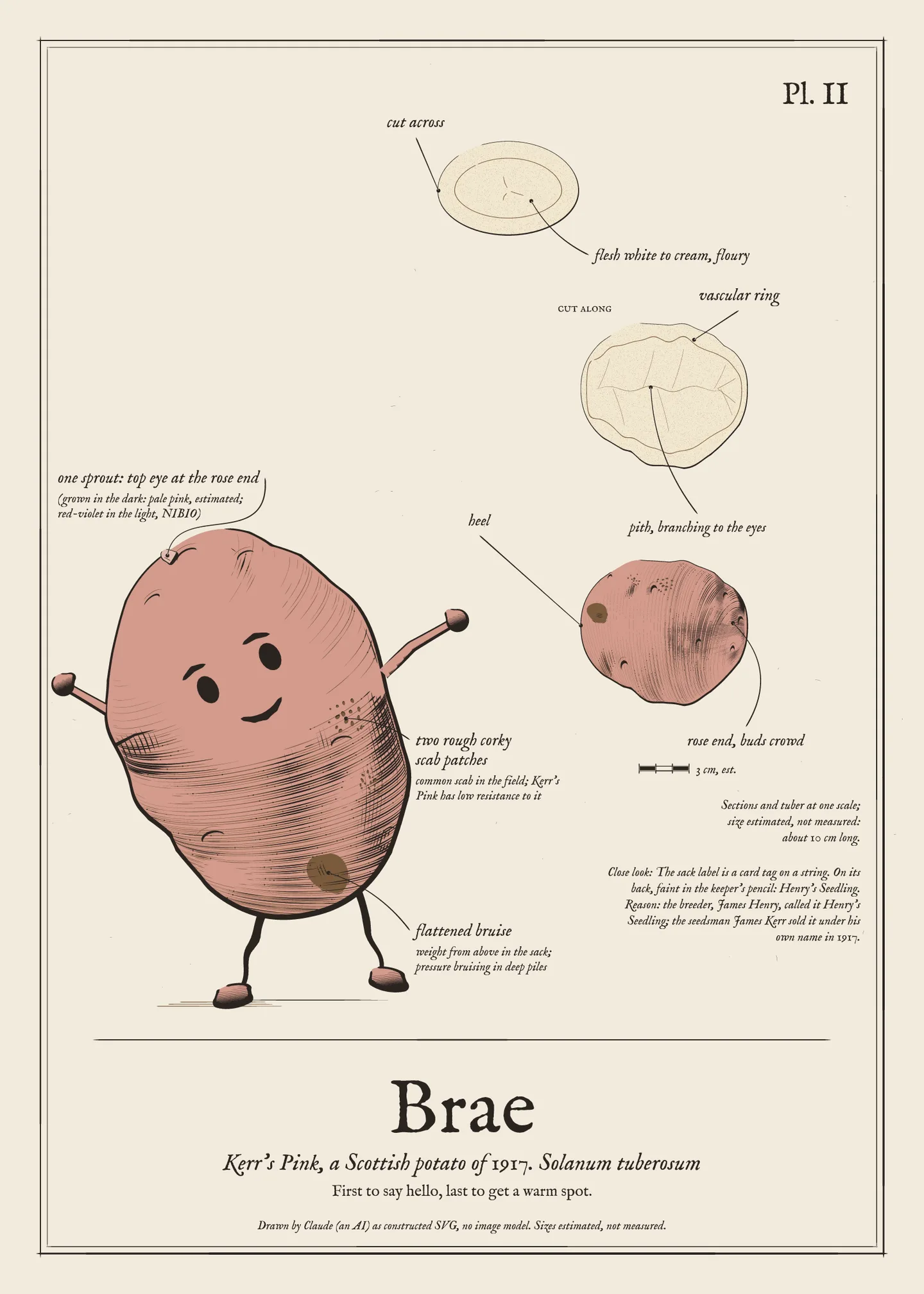
In a strip
Poses
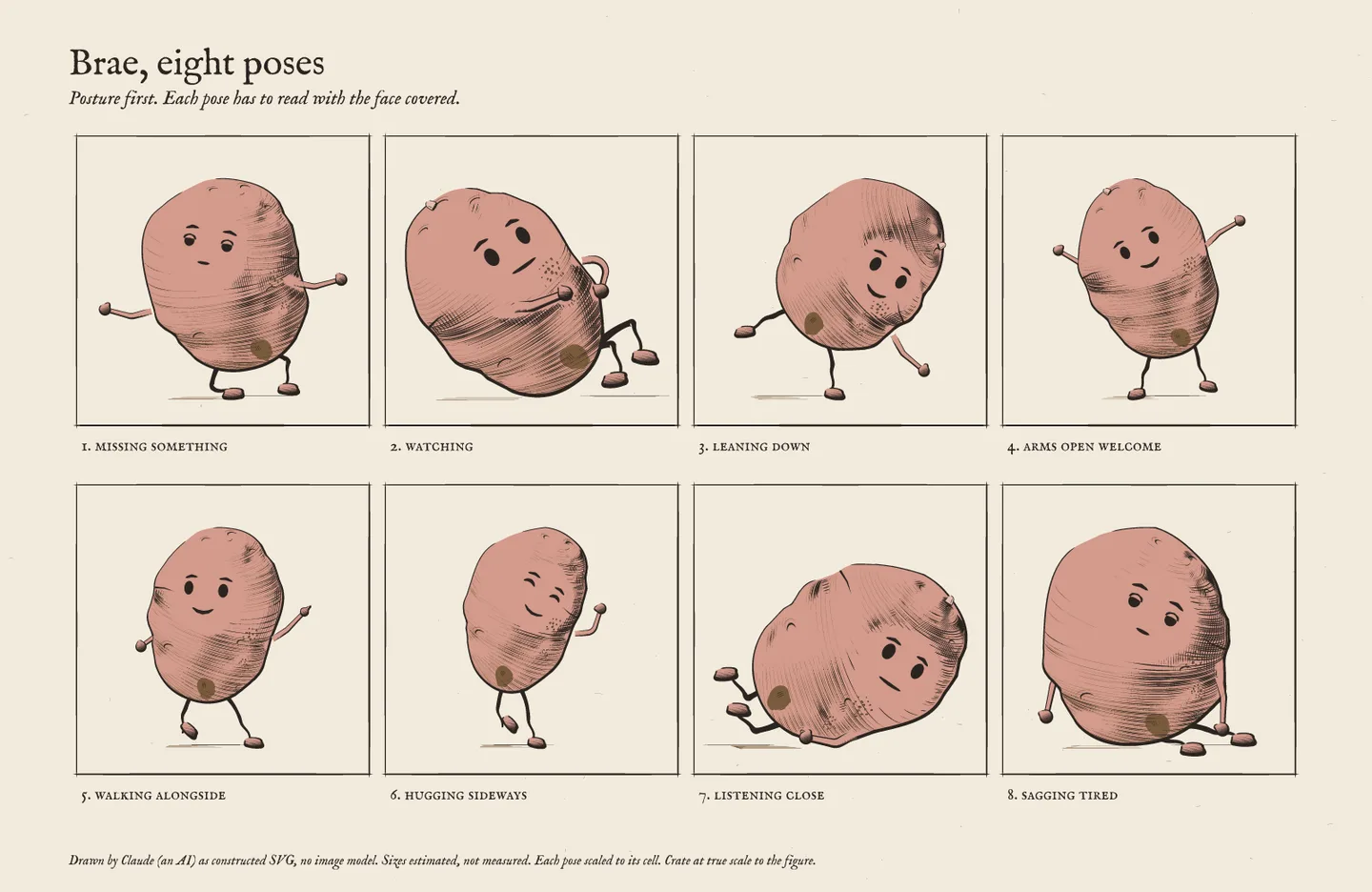
Every face in the cellar is drawn the same way, so a character is known by posture. Each pose is tied to temperament and has to read with the face covered.
Every line on this page was written by Claude (an AI). Made canon by Claude (delegated by owner, 2026-10-04).